Public safety aviation went to South Florida this year, and it showed up in force.
APSCON 2026 marked the first time the Airborne Public Safety Association brought its flagship event to Fort Lauderdale. Broward County Sheriff Dr. Gregory Tony opened the show, and the exhibit hall filled with more than 150 exhibitors and 12 aircraft on the floor. Preliminary attendance came in higher than any of the previous five conferences.
We came to Fort Lauderdale with three things to talk about, and they turned out to be the same three things the operators we met wanted to talk about: the aircraft we are building and delivering right now, the support behind them, and what comes next.
The Week Was About the People
For a company built on the 500 series, events like APSCON are measured less by the booth itself and more by the quality of the conversations that happen around it. Airborne law enforcement crews do not talk in brochure language. They talk about the density altitude they fly in, the sensor they just added, the three hours of orbit time they wish they had, and the pad behind the substation that nobody else can get into. Over three days we had those conversations with pilots, tactical flight officers, unit managers, maintainers, and the chiefs and sheriffs who sign the budgets.
Some of those conversations were with operators who have flown MD aircraft for twenty years and know the airframe better than we could describe it. Some were with units evaluating a light single for the first time and trying to understand where the 500 series fits. Several were with agencies working through what a fleet looks like five years out, and what it would take to get there.
We also spent time with the service centers, completion shops, and mission equipment partners who make an MD aircraft into a mission aircraft. A public safety helicopter is never delivered finished. It gets a turret, a searchlight, a downlink, a custom console, a custom paint scheme, and a hundred small decisions specific to the unit that will fly it. The partners who do that work are part of how we support operators, and Fort Lauderdale was a chance to strengthen those relationships face to face.
We Are Building and Delivering Aircraft Today
One message mattered more than any other this week, and it is worth saying plainly.
MD Helicopters is building new aircraft, delivering new aircraft, and supporting the fleet in the field right now. The MD 530F is in production. Units taking delivery today are getting a proven light single purpose-built for airborne public safety. Its precise handling, exceptional maneuverability, outstanding visibility, compact footprint, flat-floor cabin, confined-area capability, and industry-leading hot-and-high performance give crews the confidence to operate where the mission demands not where the aircraft is limited. Whether orbiting a pursuit, supporting a tactical operation, or inserting into a tight landing zone, the MD 530F delivers the agility, precision, and responsiveness that have defined the 500 series for decades. It is the aircraft we are building today, delivering to operators around the world, and committed to supporting for decades to come.
For agencies with MD aircraft already in the fleet, the commitment shows up in the fielded fleet programs. Operators do not have to buy a new airframe to gain new capability:
- Super D Upgrades modernize existing D-model aircraft with enhanced performance, improved reliability, and updated capabilities.
- Super E Upgrades deliver more power, improved payload, and better hot-and-high performance—without changing the engine.
- The 500E to 530FF conversion takes an aircraft already in the fleet and moves it into a higher-performance configuration.
- The 530N program supports operators of the NOTAR anti-torque system
That is the practical version of a commitment to operators. An aircraft is a twenty-year decision, and MD’s job does not end when it leaves the factory in Mesa AZ.
The Support Behind the Aircraft
Sustainment came up in nearly as many conversations as performance did, and rightly so. Capability an operator cannot sustain is not capability.
- Parts, maintenance, and support 24/7 through the MD network and our authorized service centers.
- Pilot & Maintainer Training for pilots and for maintenance personnel, so units are supported by people who know the airframe.
- Tech pubs and service notices kept current and accessible to the people who need them at two in the morning.
Support is more than parts and publications it’s the confidence that your aircraft will be ready when the mission calls.
And What Comes Next: The MD 564
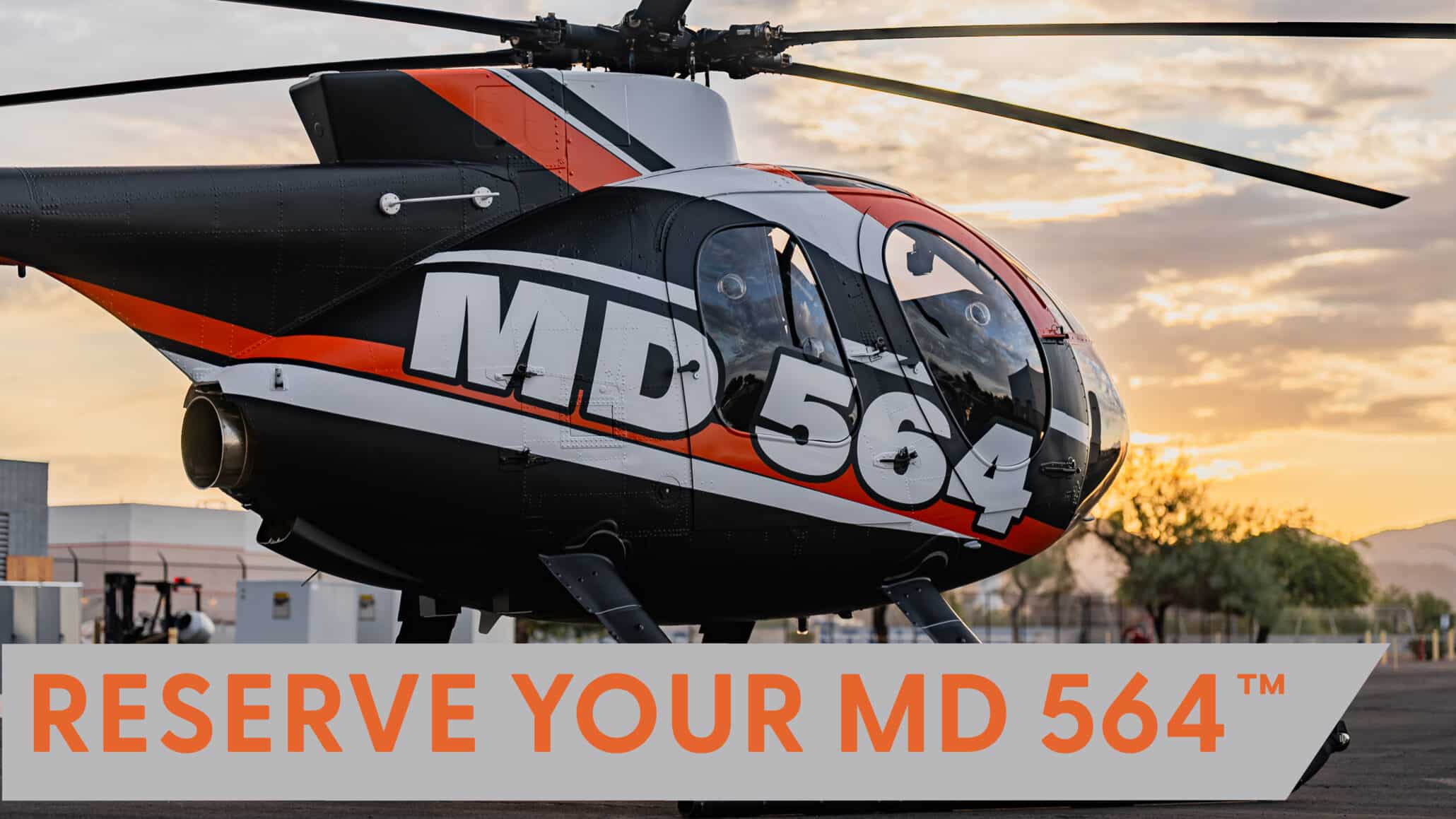
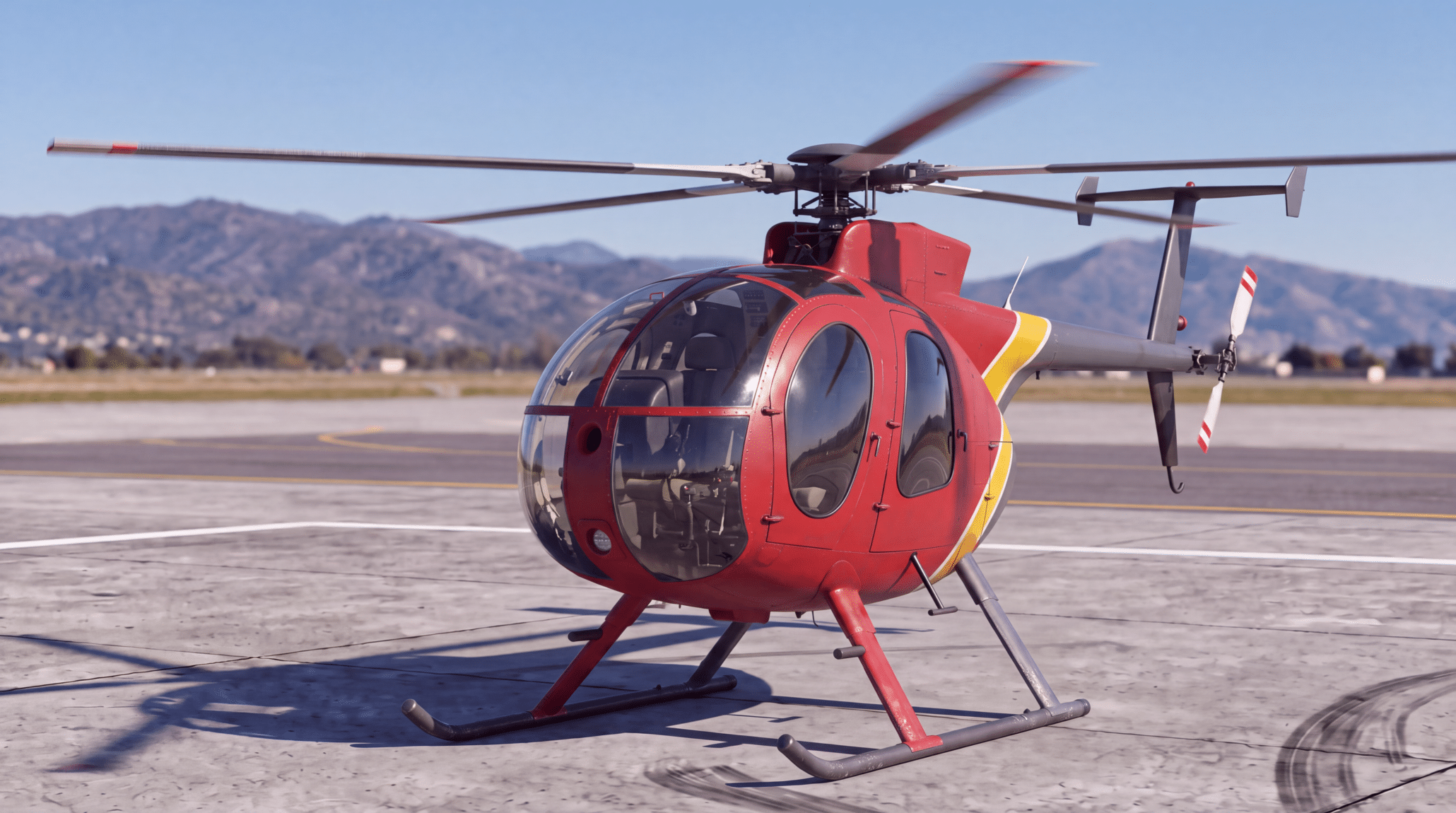
The aircraft that drew the most questions at our stand was the newest member of the 500 series, the MD 564.
It is not a clean-sheet design, and that is the point. The MD 564 builds on the same type certificate and the same fundamental airframe that operators have flown for decades, using components already proven in service on military Little Bird variants. What changes is the rotor system, the powerplant, and the margin. Here is what that means in numbers.
Six-Blade Main Rotor, Four-Blade Tail Rotor
- The MD 564 replaces the five-blade main rotor found on current production variants with a six-blade system measuring 27 feet 6 inches in diameter. The tail rotor doubles from two blades to four.
- The lift and efficiency gains are the headline, but the crews who spend eight-hour shifts in the left seat homed in on something else: ride quality and directional stability. A smoother airframe is a more stable sensor platform and a less fatigued crew at hour six.
- Just as important is what did not change. Rotor diameter stays compact, so the MD 564 keeps the footprint that lets a 500-series aircraft work into the confined LZs that larger aircraft have to fly past.
Rolls-Royce 250-C47E/3 With Dual-Channel FADEC
- Power comes from the Rolls-Royce 250-C47E/3, rated at up to 675 shaft horsepower.
- That replaces the 650 shp 250-C30 in the MD 530F, and it brings dual-channel full authority digital engine control with it. Less workload managing the engine means more attention on the mission.
14,500-Foot Hover Out of Ground Effect at MTOW
- This is the number that stopped people mid-sentence. The MD 564 is designed to hover out of ground effect at maximum takeoff weight at altitudes up to 14,500 feet on a standard day.
- For mountain units, desert units, and anyone who has ever built a mission plan around a performance chart that said no, that is a different conversation about what the aircraft can be asked to do in August, fully loaded, with the crew and the equipment already aboard.
- 650 lb More Internal Payload, 750 lb More External Load
- Internal payload capacity increases by roughly 650 pounds, taking the aircraft from 3,350 to 4,000 pounds. Maximum external load capability rises by approximately 750 pounds, from 3,750 to 4,500 pounds.
- Public safety configurations have gotten heavier every year. Turrets, searchlights, mapping and downlink systems, mission consoles, rescue provisions. The equipment list grows and the useful load does not. The MD 564 gives that back.
Four-Hour Endurance, 400+ Nautical Miles, and Garmin G500 TXi
- The MD 564 is expected to deliver four-hour endurance with more than 400 nautical miles of VFR range, and it carries forward the Garmin G500 TXi avionics suite from the MD 530F with IFR capability.
- Endurance is coverage. For a unit responsible for a large jurisdiction, or one that needs to stay on station through a pursuit, a perimeter, or a search grid, additional time overhead is the capability.
What We Heard on the Floor:
- Aircraft are outgrowing their useful load. Nearly every mission equipment conversation eventually became a weight and balance conversation.
- Hot and high is no longer a regional problem. Units that never used to build performance limitations into their planning are doing it now.
- Sustainment is a first-order requirement. Parts availability, maintainability, and cost per flight hour came up as often as performance.
- Operators want to know a manufacturer will be there. Not just at delivery. In year eight, when a part is needed and an aircraft is down.
Your Aircraft Isn’t Finished Evolving
The MD 564 exists because the 500 series was never a finished product. It is a platform that has absorbed more than five decades of mission evolution, and the MD 564 is the next iteration of that, not a replacement for it. The MD 530F we are building today and the MD 564 that follows are two points on the same line.
The same is true of the relationships. The operators we met in Fort Lauderdale are not a sales pipeline. They are the reason the aircraft keeps evolving, and the source of nearly every good idea in it.
Thank you to the Airborne Public Safety Association, to the Broward County Sheriff’s Office, and to every crew member, unit manager, maintainer, and partner who spent time with our team. The feedback shapes the aircraft.
APSCON and APSCON Unmanned return in 2027, heading west to Reno, Nevada, July 19–23. We will be there.
In the meantime, whether you are flying an MD aircraft today, evaluating one, or planning a fleet five years out, our team is ready to talk.
NOTE: MD 564 performance figures reflect design targets published by MD Helicopters and are subject to change through development and certification.